A Frank Admission: Why We Won’t Give You a Price List (And Why You Should Be Wary of Those Who Do)
Let’s get straight to the point. You’re searching for a cnc laser cutting machine price, and you’re probably frustrated because you can’t find a simple price tag online. Good. You should be.
Here at HADEN, we won’t hand you a price list. Not because it’s a secret, but because giving you a price without understanding your application, your materials, and your business goals would be irresponsible. Frankly, any company that throws a price at you without a deep-dive conversation is just selling you a box, not a business solution. This article isn’t a sales pitch. It’s an education in how to be a smarter buyer.
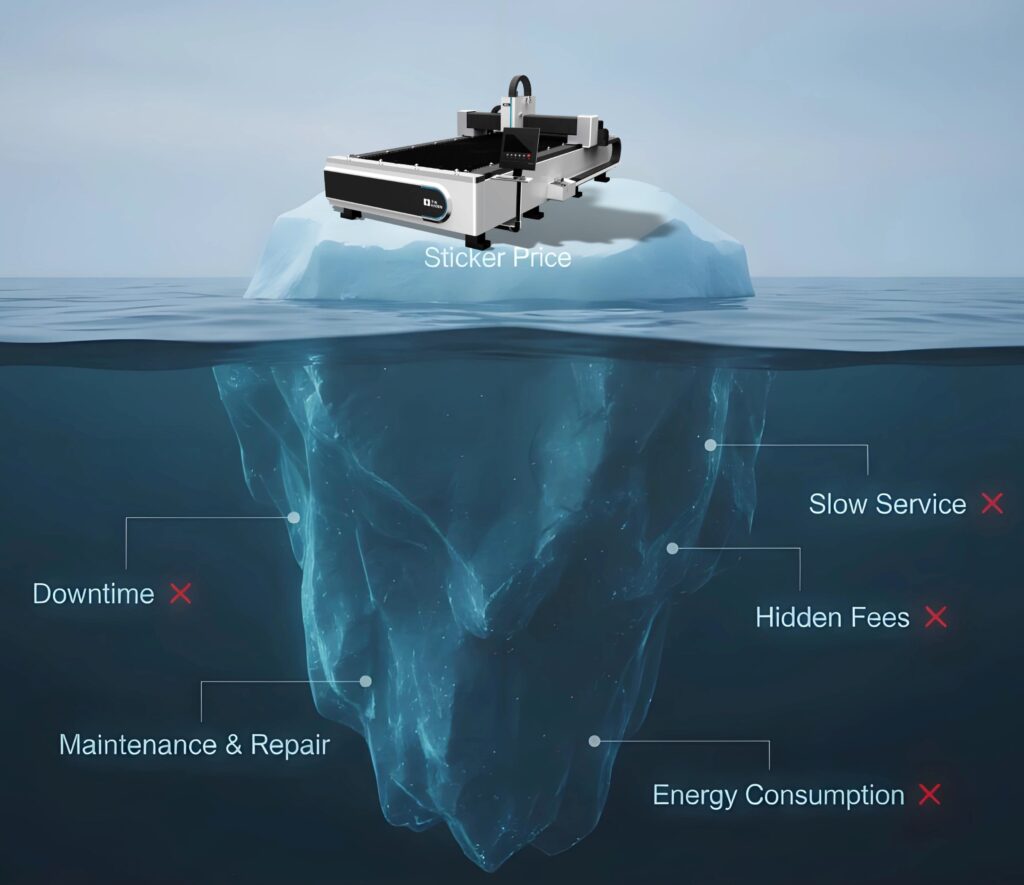
The Iceberg Problem: 90% of Your Machine’s Cost is Hidden Underwater
Think of a laser cut cnc machine’s price like an iceberg. The number on the quote? That’s the 10% you see above the water. It’s visible, obvious, and deceptively easy to compare.
The other 90%—the installation, training, maintenance, downtime, software fees, the real cost of ownership—is lurking right beneath the surface. It’s this massive, hidden part that can sink your entire investment. Your job, as an owner, is to look past the tip and understand the whole iceberg.
The “Three-Layer Price Deconstruction”: A Framework for Smart Owners
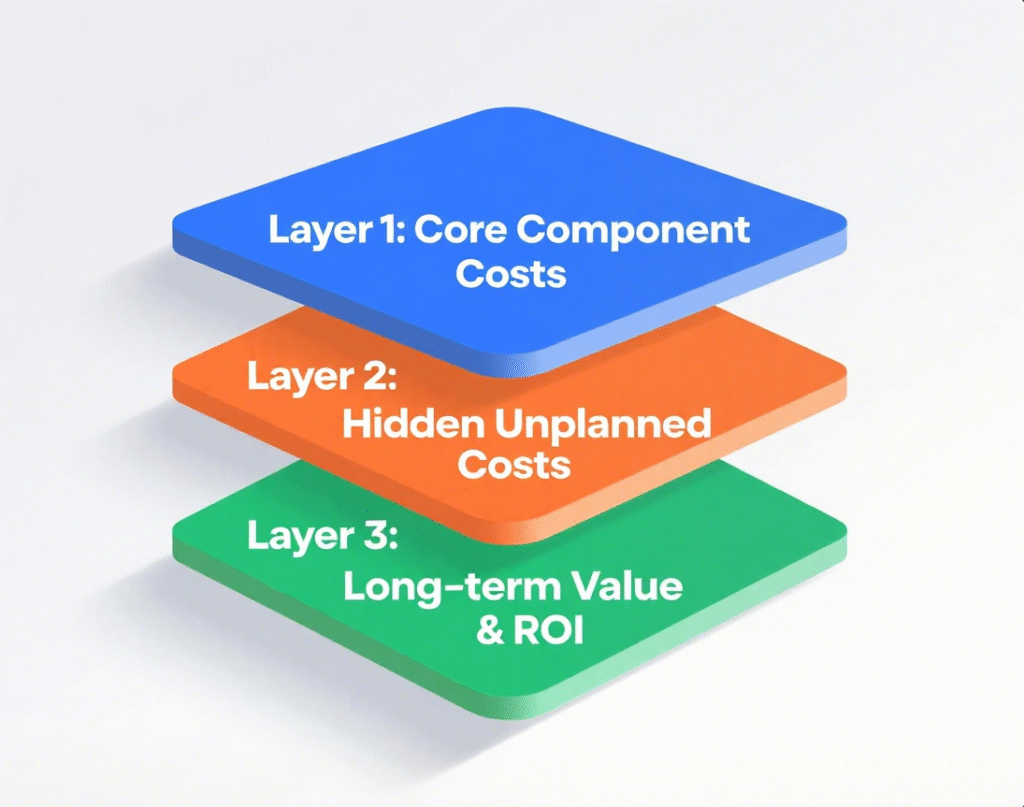
Over the decades, I’ve seen too many good businesses get burned by “cheap” machines. So, I’ve boiled down my experience into a simple framework to help folks understand what they’re truly paying for. I call it the “Three-Layer Price Deconstruction.” Let’s break it down.
Layer 1: The Tip of the Iceberg – Core Component Costs
This is the straightforward part. The upfront cost of any laser cnc cutting machine is driven by its core hardware. When you get a quote, you should see a breakdown of these key components:
- Laser Source: This is the engine. The brand (like IPG or Maxphotonics) and the power (from 1kW to 30kW and up) are the biggest price drivers here.
- Machine Bed: The size, weight, and build quality of the frame determine its stability and lifespan. A heavier, heat-treated bed costs more upfront but prevents accuracy problems down the road.
- Cutting Head: A high-quality, auto-focus cutting head from a brand like Precitec or Raytools will cost more than a basic manual-focus one, but it dramatically improves efficiency and cut quality.
- Control System & Software: This is the brain. Systems like CypCut or Beckhoff offer different levels of control and ease of use.
This layer is important, but remember, it’s just the beginning.
Layer 2: The Hidden Waterline – The “Surprise” Costs That Sink Your Budget
This is where the trouble usually starts. These are the costs that often don’t appear on an attractive initial quote. You’ve got to ask about them directly.
- Shipping, Tariffs, and Insurance: Getting a multi-ton machine from the factory to your floor is a significant, and often underestimated, expense.
- Installation and Commissioning: Who is installing it? How many days will it take? Are their travel and accommodation included?
- Operator Training: Is training included? Is it just a few hours, or is it a comprehensive program that ensures your team can actually run the machine productively?
- Software Licenses: Is the software a one-time purchase, or is there an annual subscription fee?
Listen to me on this one. We once saw a factory buy a machine from a different supplier to save 20,000.Lookedlikeagreatdeal.Butinthefirstyearalone,theylostover20,000. Looked like a great deal. But in the first year alone, they lost over 20,000.Lookedlikeagreatdeal.Butinthefirstyearalone,theylostover50,000 in downtime and unexpected repair bills because the support was non-existent. That “cheap” machine became the most expensive piece of equipment they owned.
Layer 3: The Deep Foundation – The Long-Term Value That Truly Defines Your ROI
This is the layer that separates a smart investment from a costly mistake. It’s not about what you pay today; it’s about what the machine earns (or costs) you over the next five to ten years.
- After-Sales Service & Support: When your machine is down, you are losing money every single minute. How fast can a qualified technician be at your door? Is support available in your time zone? What does the service contract really cover?
- Consumable Parts: Nozzles, lenses, ceramic rings. What’s their expected lifespan and replacement cost? A machine that burns through cheap consumables can bleed you dry with a thousand small cuts.
- Stability and Reliability (MTBF): Ask for the machine’s Mean Time Between Failures. A reliable machine that just runs, day in and day out, is worth its weight in gold. As the Manufacturing Productivity Institute often reports: for industrial equipment, the Total Cost of Ownership (TCO), not the initial purchase price, is the only true benchmark for a successful investment.
So, How Do You Calculate the True Price?
The real price isn’t a number a salesman gives you. It’s a calculation you make yourself. Before you sign any check, run through this checklist.
The Smart Buyer's Checklist:
Stop Asking for a Price. Start Asking for a Profitability Analysis.
If you've made it this far, you get the secret: buying a CNC laser cutter isn't a purchase, it's a capital investment. The "Three-Layer Price Deconstruction" framework is just one piece of a larger puzzle. It's a direct reflection of the financial aspect of our core “P.O.S.T. Heartbeat Assessment” methodology.
If you're ready to stop shopping for prices and start planning for profits, then it's time to take the next step. We encourage you to read our master guide on making an intelligent machine investment. There, we'll show you how to assess a machine's total impact on your business, far beyond the price tag.
Read the guide here: [The Factory Owner's Guide to Laser Cutting Machine ROI]